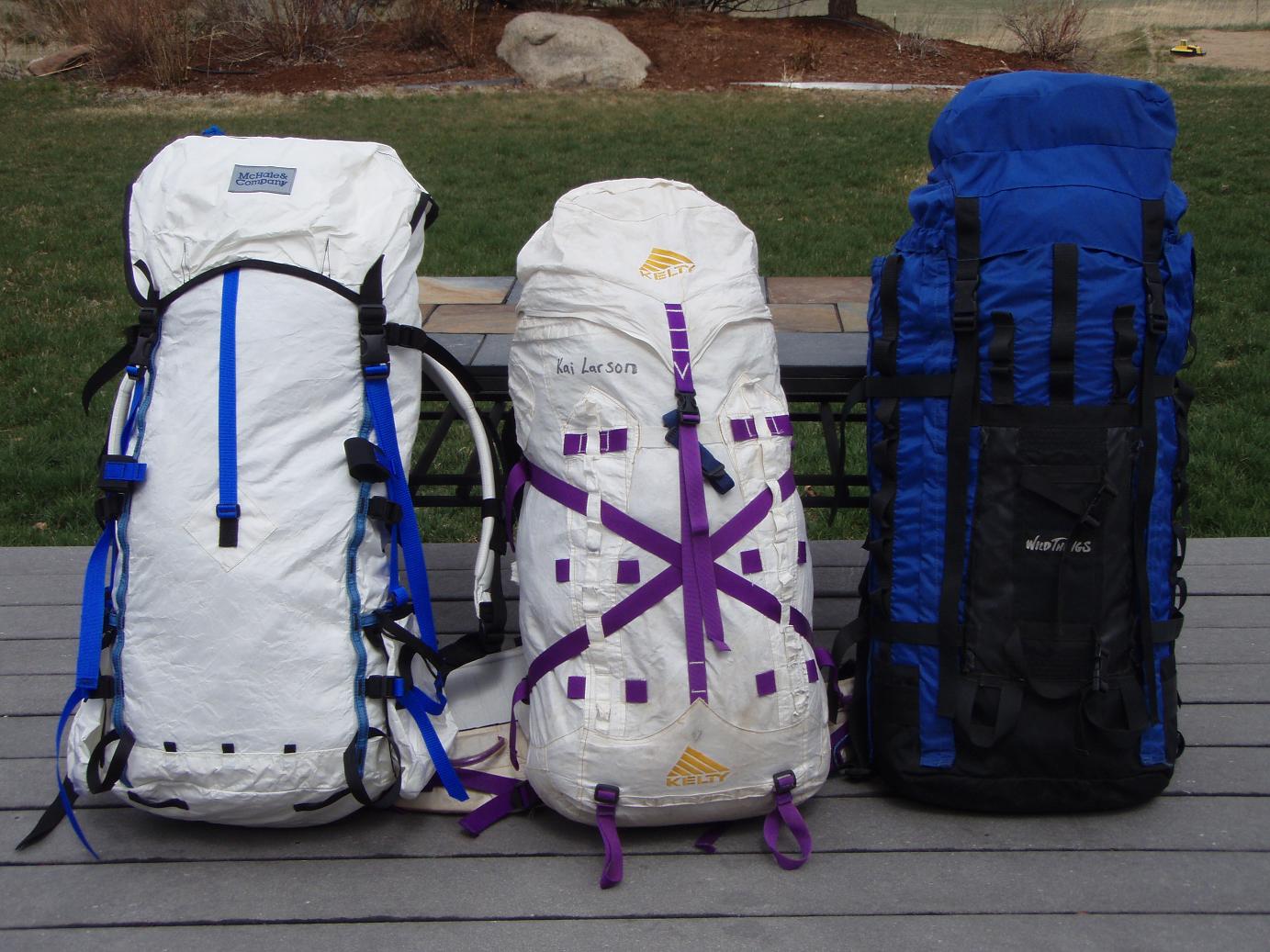
| McHale SARC, Kelty Cloud 60, Wild Things Andinista |
 |
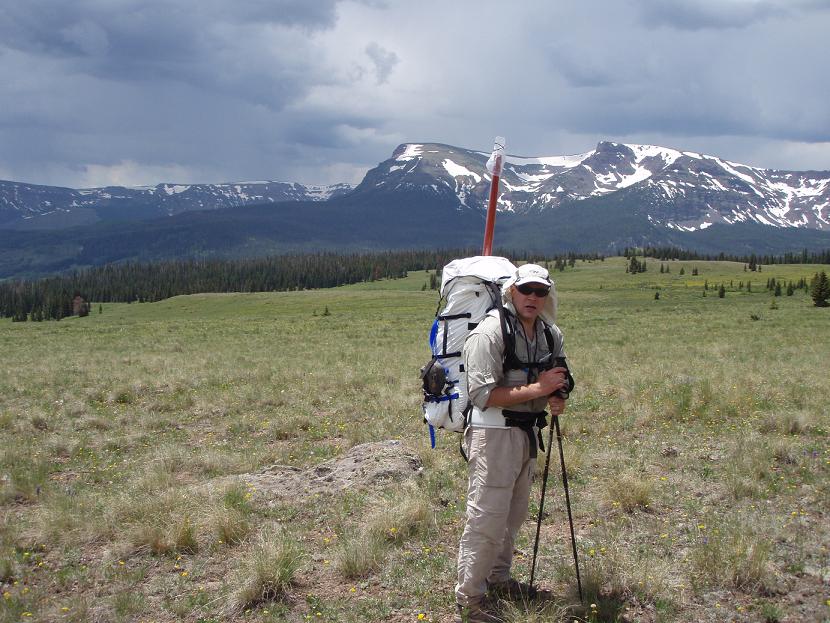
| McHale SARC in the Flat Tops Wilderness |
 |
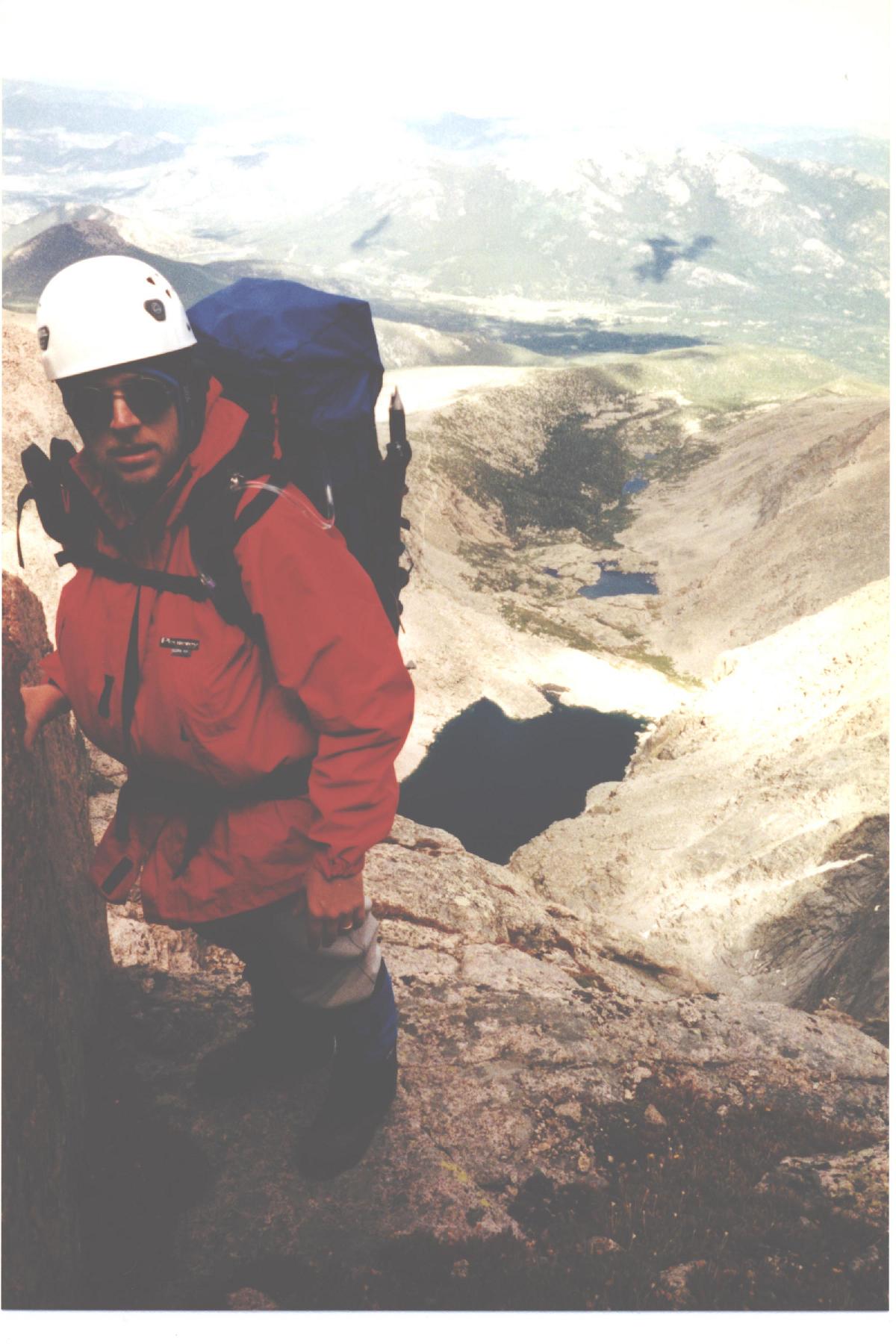 |
| Andinista on the Approach to the Notch Couloir, Long’s Peak |
The idea behind the Andinista is that it is an ultralight pack which can carry your all of your base camp and climbing junk to a high camp, then compress down into a high performance climbing pack for the technical climbing when you are carrying only minimal climbing gear. I really liked the concept, but have not used the pack as much as I might have because I of the compromises inherent in the Andinista’s design.
First the negatives: It is this pack’s climbing performance that really disappointed me. The Andinista is long and tall, and when I climb with this pack, I find myself constantly banging the back of my helmeted head on the top of the pack. There is no readily apparent way to adjust the top of the pack away from your head, because the soft frame can’t be bent back out of the way (but see below.) This problem alone has caused me several episodes of extended cursing after repeatedly having my helmet knocked down over my eyes. Part of the problem is that the straps that run from the back of the pack to the top lid are attached too high on the pack body (I guess to keep them out of the way of ice axes strapped on the back of the pack.) This makes it impossible to crank the top lid down and move it out of the way of your helmeted head. Lately, I have taken to looping these straps down through the crampon attachment straps, then back up to the top lid. This allows me to crank the top lid down hard, which pulls it away from my head, increasing headroom dramatically.
The other problem I have with the pack’s climbing performance is that the load lifter straps don’t function to take weight off of your shoulders. Even with a relatively light load (10-25 pounds), I like to take the load off of my shoulders so when I am reaching up or swinging ice tools, the motion of my arms and shoulders isn’t impeded by the pack straps. If you can move your arms and shoulders freely, without being locked into the shoulder straps, the stability of the pack is improved as well.
The other odd thing about the shoulder straps is that the adjustment slider buckles are located at the bottom of the strap and oriented upside down compared with other packs. I’m not sure what advantage this is supposed to confer, but I find it more difficult to adjust the straps, and there is more slippage as well when compared with normal buckles.
The Andinista doesn’t really allow you to lift the load off of the shoulder straps. This issue is exacerbated with additional weight. When climbing with 20-30 pounds in the pack, I found that I really missed load lifter straps that would allow me to hip load more of the weight when climbing.
For carrying loads (as opposed to climbing) the Andinista carries reasonably well considering the minimalistic frame and suspension, provided you pack it carefully. It is adequate for carrying climbing gear and lightweight bivi or camping gear on the approach. Loads of more than 40-50 pounds are really outside the design of this pack, and if you have to carry more than this, you need a different pack, or else you are going to have an aching back and shoulders. One trick I used to make the pack carry heavier loads better on the approach was to buy a sheet of polyethylene plastic sheeting and cut and trim it to fit in the frame pocket along with the folded evazote pad. This gave the pack better load carrying characteristics for the hike in, and the plastic frame sheet was easily removable for climbing. I also augmented the waistbelt with a slightly larger lumbar pad, which also improved carrying comfort.
I’m not a fan of tube-style ice axe holders, so I cut off the ice axe tubes on the back of the Andinista and replaced them with traditional loops, which work better with my rubber coated bent shaft ice tools.
I really wanted to like this pack. It is light, versatile, and well made. The Andinista has an impressive pedigree and has been used on climbs that are way harder than anything I would dream about climbing by climbers who are way better and more experienced than I will ever be. However, the Andinista is a pack of compromises. Its performance carrying heavy loads is mediocre, and for hard climbing, I prefer a pack with better head room and with the ability to shift the load off of my shoulders, two areas where the Andinista comes up short.
However, I still find myself using it occasionally, when I want the simplicity of a single pack that will carry my stuff to camp and then convert into day-pack size for the climb, where I will only be carrying very little weight. For this specialized purpose, it functions better than most anything else I’ve used.