Camera equipment for backpacking and climbing.
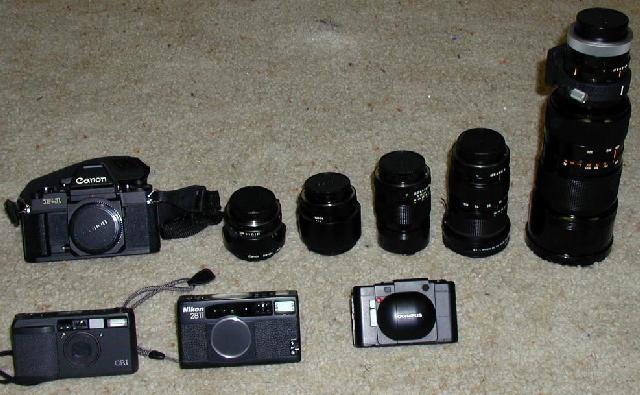
Canon F1; 24mm f:2.8; 85mm f:1.8; 135mm f:2.8; 35-105mm f:3.5; 85-300 f:4.5
Ricoh GR1; Nikon 28Ti; Olympus XA
When deciding what to take with me, the first thing I ask myself, is how much emphasis I plan to place on photography for a particular trip. In other words, what amount of time, energy, weight of camera equipment, and mental effort am I willing to allocate to taking pictures. Unfortunately for me, if it is a climbing trip that is at all challenging (and most all climbing is challenging to me because I’m not much of a climber) I acknowledge that I am going to have my hands full just climbing, and photography is relegated to second or third string. For backpacking, I tend to take more pictures and bring more camera gear, particularly if I am not carrying a super heavy pack.
I usually go to one extreme or the other with carrying camera gear into the backcountry: I either carry only a single fixed lens pocket camera, or I carry a SLR with 2 to 4 lenses, usually in addition to a pocket camera. My rationale is that if I’m going to carry the weight of a SLR, I might as well benefit from an array of lenses for the camera.
My first rule is that if I’m going to carry a camera, I try to keep it as accessible as possible. This means finding a way to carry your camera where you can get to it easily. For climbing, however, I have not found a satisfactory method of carrying a SLR other than in my back pack. I’ve tried various fanny packs and suspension options, and they all interfere with movement and balance too much. So, for those climbing trips when I do bring along my SLR, it goes in my pack, and comes out occasionally at belay stances and the like when I can get to it safely. I used to carry my SLR in my backpack on all my climbing trips, but found that I rarely got it out. Now, I generally take only a pocket camera, particularly if a climb is difficult or long and weight is an issue. My pocket camera either goes in a shirt pocket or rides in a pouch on my pack shoulder strap. It is easy to access, and I take more pictures with it. The pocket camera doesn’t have the flexibility of an SLR, but for climbing, all of the pictures I take with the pocket camera are better than all the ones I didn’t take with the SLR. I still occasionally carry a SLR on climbing trips, but if the climb is long and/or hard, the big SLR and lenses are some of the first things to get left behind. For climbs with a “base camp” I will usually carry my SLR to base camp for taking scenic pictures, but leave it at camp for the actual climbing.
For backpacking, carrying options for an SLR are better, and weight is less critical, so I carry a SLR much more often. I like to carry the SLR attached to either my hip belt, the side of my pack down low, or clipped from both shoulder straps. All of these carrying locations give access without having to take off my pack. I use a generic padded camera case, large enough to hold the camera with a medium telephoto lens mounted, and I attach it to the pack with accessory carabiners.
SLR Equipment:
I have gone through several different SLR cameras. I started out with several of the cheaper SLR cameras, and after breaking them all, decided to get a professional camera. I decided on the Canon F1 (the latest F1 model), and it has served me well for twelve years and several thousand pictures. It is built very tough, and has both electrical and fully mechanical shutter mechanisms, so if your batteries die, you still can shoot from 1/60 through 1/2000 without the need for batteries. I just took it in for a full check-up and overhaul, and after years of use and countless dings and drops (several of which shattered the lenses on the camera) and exposure to weather and temperature extremes, the camera was still working perfectly. Unfortunately, the Canon F1 is no longer made.
I have used some of the more modern auto-focus marvels which are out there now, and they are truly amazing as to what they can do. However, for shooting pictures in the backcountry, I prefer old fashioned manual focus systems that have only minimal reliance on batteries and sensitivity to cold. Backcountry photography is hard on camera equipment, and I want the simplest, lightest, and toughest gear I can get. Unfortunately, autofocus has pretty much taken over the market and there are fewer options now available in manual focus cameras. My favorite currently available manual focus camera is the Olympus OM series. I don’t own any of the OM cameras, but have used them on occasion. They are light, compact, well thought out, and have a reputation for reliability. The OM3 and OM4 are pro cameras. They have a nice multi-spot metering option that works well for strange lighting. The new OM2000 is a fully manual camera with an all mechanical shutter mechanism. It’s only about $260 including a 35-70mm zoom lens. (For some reason, price of the body only without the lens was the same at most places I’ve seen.) If my Canon F1 ever dies, I’ll probably replace it with an Olympus if I can’t find another F1.
My SLR set up consists of my tried and true Canon F1 and the following manual focus Canon lenses:
24mm f:2.8
85mm f:1.8
135mm f:2.8
35-105mm f:3.5 (constant aperture)
85-300mm f:4.5 (constant aperture)
My standard backcountry SLR kit consists of the F1, the 24mm lens, and the 85mm lens, or sometimes the 35-105mm lens. The 24mm is ideal for broad landscapes. The 85 gives me a reasonably fast lens for low light conditions. I prefer the 85 to the standard 50mm lens because it takes better portraits, and the greater magnification of the 85 is good for bringing details a bit closer. The 35-105 zoom is a good all-purpose lens, with sharpness that is almost as good as the fixed lenses.
If I am expecting to have opportunities to photograph wildlife, I will often bring the 135mm, or even the 85-300 zoom. The 85-300 is a wonderfully sharp lens, but it weighs a ton, and to date, I haven’t yet taken any wonderful National Geographic wildlife shots with it. I still carry it occasionally, on backpacking trips where I’m expecting to see lots of wildlife, in the hope I will spot a cougar or some other elusive, photogenic animal.
In spite of the superiority of the SLR system, my pocket camera gets more use than the SLR these days. The weight, bulk, and convenience of a pocket camera is better than that of a SLR system, and I think I have finally realized that my chances of getting anything published in National Geographic are about as good as my chances of red-pointing 5.13. Any more, I am mostly looking for scrapbook photos to memorialize my adventures. I do, however, still want good picture quality and the ability to blow my pictures up into good sized enlargements. I also want some control over exposure, particularly the ability to compensate for snowy backgrounds. The requirement of good quality lens, coupled with exposure control narrows the field of pocket cameras considerably. Over the years, I have tried several pocket cameras. My favorites are the Nikon 28ti, the Ricoh GR1, and the Olympus XA. These are all excellent cameras, but each has its good and bad points.
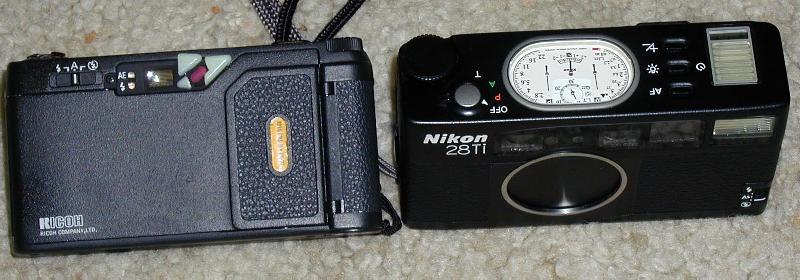
Richoh GR1 (with plastic pieces glued around the red on/off button) ; Nikon 28Ti
The Olympus XA is a great climbing camera. It is very compact and light weight, slipping easily into a shirt pocket. The small battery lasts almost forever. The 35mm, f:2,8 lens is quite good, and by about f: 5.6 is capable of producing excellent enlargements up to 11 x 14. The exposure control is aperture priority only. There is an exposure compensation lever that allows you to adjust for snowy backgrounds, and for even more compensation, you can simply adjust the film speed ISO setting. The bad points of this camera are the manual rangefinder focusing mechanism, which is a bit hard to use in low light situations, particularly when wearing glasses. The shutter speed read out in the view finder is similarly difficult to see some times. The frame counter on the XA was poorly designed and almost invariably will malfunction. I have had two of these cameras, both had faulty frame counters, as did the XA’s of two of my friends. This isn’t a huge deal, but can leave you guessing as to just how many pictures you have left on a roll of film. I haven’t had any other reliability issues with my XA’s, and they have functioned well for me in spite of relatively harsh treatment and use in extremely cold conditions. The XA has no built in flash, although a compact accessory flash is available. The case of the XA is quite smooth and slick, which led to the demise of my first XA when it slipped out of my hand and dropped about 900 feet. The biggest drawback of the XA is the fact that it is no longer made, although you can get a used XA from places like KEH and B&H for anywhere from $75 to $200 depending on condition.
The Ricoh GR1 is a truly tiny camera, especially considering that it has autofocus, automatic film advance and a built in flash. It is about the size of a pack of cigarettes. It has a very sharp 28 mm f:2.8 lens. It has programmed and aperture priority exposure control, and exposure compensation for funky lighting conditions. It has a rugged, magnesium case. This is a great camera, but has a couple of annoying traits which keep it from perfection. The first is that the autofocus mechanism is a bit finicky. It often takes several tries and a fair amount of tilting the camera back and forth to obtain a focus lock. The other truly annoying trait of the GR1 is that the on/off button is extremely susceptible to getting activated unintentionally. The camera is constantly turning itself on while in your pocket or even when carried in a pouch. This can become a real headache after a while. I finally cured the touchy on/off button problem by cutting up some small pieces of plastic and super-glueing them in a circle around the on/off button to make the button more recessed and protected from inadvertent pressure. With this modification, which took about 20 minutes, I have had no further problems with the camera turning on by itself, although it is now harder to turn on and off when wearing gloves. I used to hardly carry the GR1 at all because of the on/off switch issue, but now it is my camera of choice for carrying in my shirt pocket. I bought mine for $325 at B&H. I have heard rumors that this camera is no longer being imported into the U.S.
The Nikon 28ti has a 28mm f:2.8 lens. The lens is extremely sharp, with optics that are almost (but not quite) as good as a fixed length SLR lens. The Nikon is heavier and bulkier than either the Ricoh or Olympus. It has aperture priority and programmed exposure, and exposure compensation. The controls and readouts are all analog dials and needles and are very easy to read and adjust. All of the exposure information is easily readable without having to peer through an undersized viewfinder. I can work all of the dials and knobs even when wearing gloves. The light metering on the 28ti is exceptionally sophisticated, and can handle some very strange lighting conditions very well. The 28ti has active autofocus, which is very reliable, but takes about a second or more to lock, so quick action shots are difficult because of the delay between pressing the shutter button and taking the picture. The camera has a titanium body and is quite robust. I managed to drop it and it bounced about 25 feet down a slope, landing on rocks. The only damage done was a sticky lens cover, which needed help retracting. This was repaired for about $70 by Nikon. The biggest drawbacks to this camera are the size (a tight fit in your pocket, but fits easily into a small pouch), and the price (about $900).
Of these cameras, I usually use the Ricoh GR1 when I have to carry a camera in my pocket. Its tiny size makes it very easy to take with you, and it doesn’t ever get in my way. The Nikon is on the large end of pocket cameras, so I usually use the Nikon when I am carrying a pack and can carry the camera in a pouch mounted on the pack shoulder strap. Overall, I think that the Nikon lens is slightly sharper, and the more positive Nikon active auto-focus, which doesn’t require multiple attempts to get a lock is a plus when you don’t have a lot of time to fiddle around taking a picture. The tiny size of the GR1, however makes it a very convenient and unobtrusive to carry, particularly when climbing. If I could only choose one, it would probably be the Nikon, but the GR1 is a close second.
Pocket Cameras vs. SLRs
In spite of the fact that I use some of the highest quality pocket cameras made, none of these pocket cameras produce pictures which are as consistently sharp as those taken with my prime SLR lenses. You can get sharp pictures with the pocket cameras, but you must pay closer attention to aperture and lighting than with the SLR. The option of full manual control coupled with a broader range of lenses that have better performance at wider apertures (and better overall sharpness) makes the SLR a superior photographic tool, and even though I carry the SLR much less than my pocket camera, a disproportionate share of my pictures which I choose to enlarge are taken with the SLR.